
Who you are becoming is revealed in how you hold your body and how you move through space.
I used to think fitness was about the body. Becoming was about the mind. And identity was something you figured out once and carried forward.
Turns out, they’re the same conversation.
Identity Isn’t Fixed. It’s Practiced.
The body is where identity gets tested. Movement is where becoming happens in real time. Every rep, every lunge, every conscious return to your spine is a quiet act of becoming — a dot connecting who you’ve been to who you’re growing into.
Not just in the gym. In the moments that challenge your ground — when the pressure is on, when the stakes are real, when the wobble shows up uninvited.
Fitness, for me, is never just about the body. It’s a laboratory for the self. This is the essence of the Fit to Lead approach — where physical practice becomes a deliberate training ground for the inner capacities that leadership demands.
This is where I explore the edges of my identity — what I collapse under, what I hold firm on, what I’m still learning to carry.
I don’t separate my fitness practice from my inner work anymore. They’re one practice. One inquiry. One ongoing question:
Am I moving like the person I’m becoming?
Because the body doesn’t lie. It shows you exactly where you are in your becoming.
In Start With Who, Marcus Marsden makes a compelling case that identity is not the outcome of performance — it is the foundation of it. Where most frameworks ask you to start with why, goals or purpose, Marcus argues for a deeper starting point: who you believe yourself to be. And here is what struck me most — context doesn’t just shape performance. Context reveals identity. And identity, in turn, shapes the context you create around you. They are in constant conversation. (Yes, he is also my husband. Living with this man means the dinner table conversations come with footnotes.) 😄
Which means the work of becoming is never just about doing more or thinking differently. It begins with the willingness to look honestly at the beliefs you hold about who you are — and who you are still capable of becoming.
What the Science Says
This isn’t just philosophy. There’s a growing body of research connecting physical posture, movement, and identity.
Neuroscientist Antonio Damasio proposed that the self is not purely cognitive, it is rooted in the body’s continuous signaling to the brain. We don’t just think our identity. We feel it, through posture, breath, and movement.
Psychologist Amy Cuddy’s research on embodied cognition showed that how we hold our bodies influences not just how others perceive us — but how we perceive ourselves. Posture shapes our felt sense of confidence and the stories we tell about who we are.
Peter Levine and the field of somatic psychology suggest that unresolved experiences may shape the body’s patterns of tension, collapse, and rigidity — often long before they surface as conscious thought.
And proprioception — the body’s ability to sense its own position in space is increasingly understood as a foundational element of self-awareness. How we orient ourselves physically is deeply tied to how we orient ourselves psychologically.
Whether contested or confirmed, each of these perspectives gestures toward a consistent indicator: one I see reflected in my work with leaders every day. The body is not merely a vehicle for the mind. It is a co-author of identity.
Training the Capacity — In the Body
So how do I actually work with this? Here’s one practice I return to regularly. (Watch the video.)
The crossroads I see most often in my work with leaders:
How do I speak up without collapsing or becoming aggressive? How do I stand for what matters to me while remaining open to another person’s point of view?
This is where presence meets identity. And where the real work begins. 🔥
For me, this is not just a mindset practice. It’s a somatic one.
How do I speak up without collapsing or becoming aggressive? How do I stand for what matters to me while remaining open to another person’s point of view? Here’s how I articulate it, somatically speaking.
Ok. Let me break down the movement for you.
The bag behind my back and arms parallel to the floor create a constraint, an invitation to stay aligned with my structural integrity. My spine. My core.
The forward lean and lunges? A practice in standing my ground, what it means to move with intention and care.
You’ll notice the two-step approach with my Base of Support (BOS)—one of my favourite somatic practices that I teach, whether I’m facilitating a leadership programme, a somatic workshop, or on the fitness floor.
As I shift my weight forward, there is a wobble. I welcome them, because the wobble isn’t a mistake to eliminate. It’s feedback. It’s part of the game.
It keeps asking: “What matters here?” “What is my purpose?”
The work is not about becoming perfectly stable. The work is learning to engage with instability. That’s where the growth lives.
The final movement is me challenging my capacity to return to my ground; navigating the dance between what’s negotiable and what’s non-negotiable in life. Hand behind my back once more. Integrity intact.
This movement is also an embodiment of a framework that has stayed with me — one introduced by Angela Cusack on the spine as a metaphor for identity. Angela shared this in an Identity workshop that Marcus and I co-led together just this past weekend — and it resonated well with our participants. The spine is not just structural. It represents what you stand for. What you will not compromise. And what you are willing to bend toward. In Angela’s work, the spine becomes the physical map of the negotiable and the non-negotiable; the places where you hold firm, and the places where genuine openness lives. When I move through this practice, I am not just training my body. I am rehearsing that distinction. Again and again. Until it becomes less of a concept and more of a way of being.
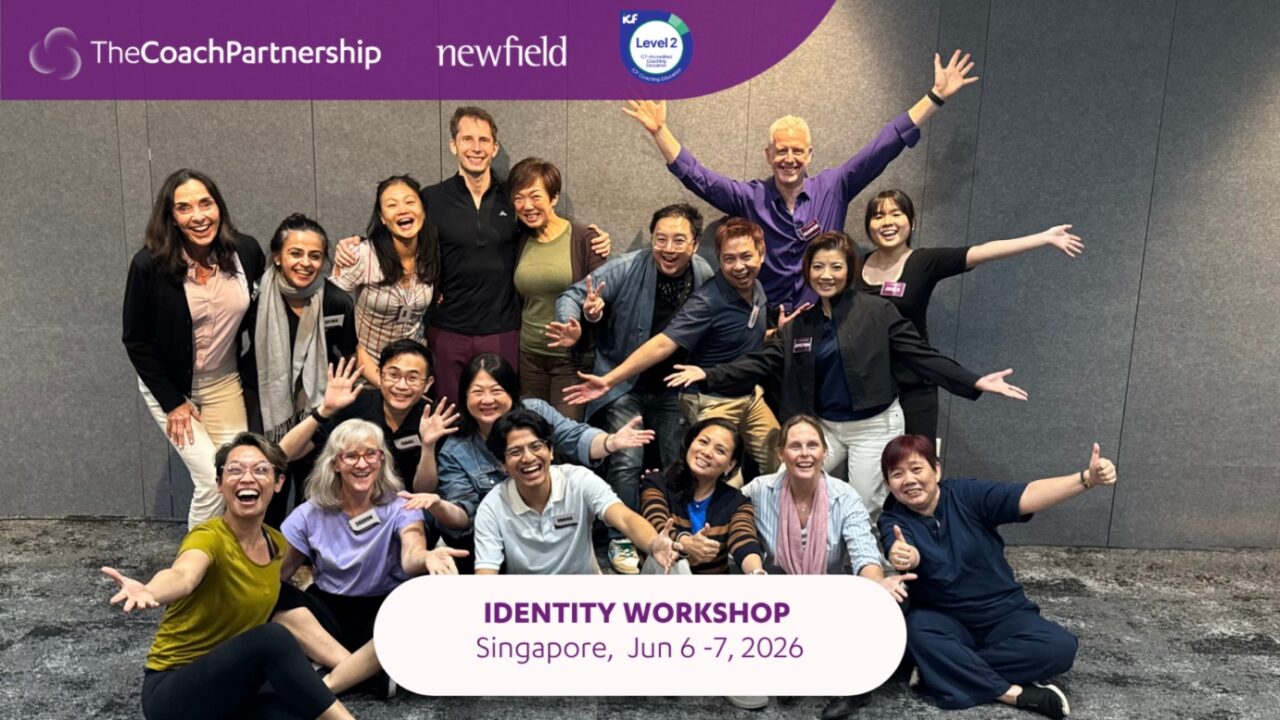
What a vibrant community! What a vibrant community! 💜 Leaders, coaches, lifelong learners, and people committed to their own growth and the growth of others.
A rich weekend exploring Identity as the Invisible Context, together with Angela Cusack, Marcus Marsden, and a room full of brilliant coaches and leaders. Singapore, 6–7 June. Celebrating The Coach Partnership’s 20th program of Newfield in Asia.
One Practice. One Inquiry.
This is how I integrate fitness and somatic practice into everyday leadership — not as exercise, but as a way of building the capacity to stay grounded, aligned, and purposeful when it matters most.
The dots between identity, becoming, and movement are not metaphors. They are the method.
Every time you step into a lunge, you have a choice.
Collapse. Overreach. Or find your ground.
The same choice shows up in every difficult conversation, every moment of uncertainty, every crossroads of becoming.
How are you moving through yours?
P.S. Lunges are not the only way in. They just happen to be my go-to practice lately, with the work that requires me to stay on my ground and yet be flexible in my approach. The practice is less about the movement you choose and more about the quality of attention you bring to it. Find yours. If you’re exploring movement as a somatic practice, working with a movement coach is always recommended. 😊
Curious about integrating body and leadership? Or interested in exploring the Newfield ontological approach to coaching, leadership, and human development?
Trainer and Coach, The Coach Partnership and The Works Partnership
Co-Author of Fit To Lead and The Purple Book of Coaching